
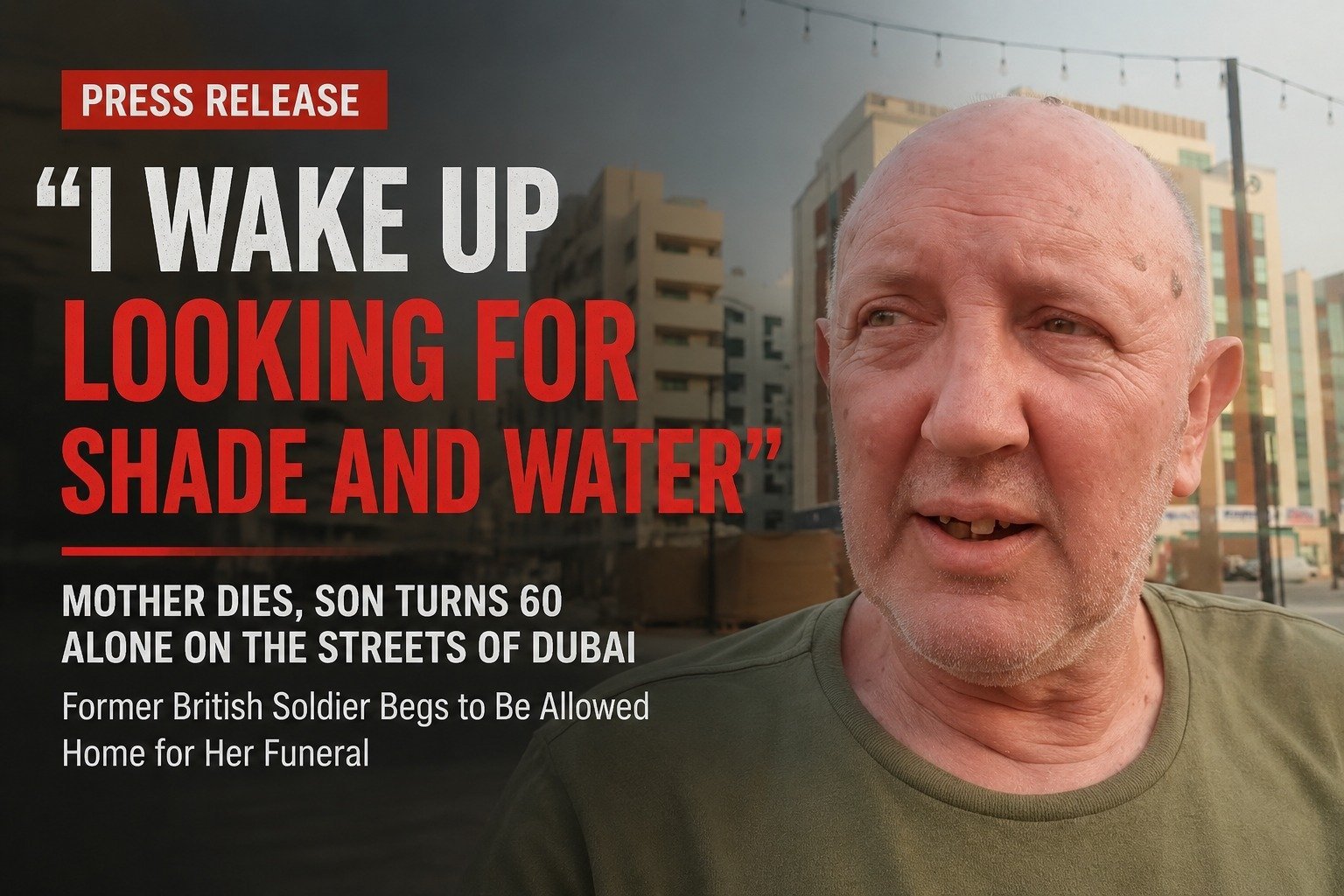
As Irish/British John Murphy wakes on his 60th birthday, he has no home, no bed, no certainty of his next meal, and no way of saying goodbye to the mother he has just lost.
Patricia Reidy/Murphy died tragically from a brain haemorrhage. She is survived by her only son John who is currently living rough on the streets of Dubai due to being blocked from working since 2017 and no home or food in the brutal summer heats of Dubai. He is prevented from attending his mothers funeral due to the UAE government prohibiting him leaving the country.
Instead of standing beside his family in Ireland to bury Patricia Murphy, who died suddenly from a brain haemorrhage, the former British soldier remains trapped in Dubai, sleeping rough under a relentless summer sun after spending more than a decade unable to leave the UAE.
His birthday, which should have been spent surrounded by loved ones, is instead another day searching simply for shade and drinking water. At a time when wealthy Emiratis descend on cooler European climates, John is trying to survive while facing grief over his mother and a lack of medical attention for aggressive skin cancer from the brutal sun.
"My biggest issue is finding shade and potable water. Your instinct every day starts with that. It's a brutal existence and I have my military training to fall back on, even after all these years."
Murphy, an only child, says the pain of missing his mother's funeral will remain with him for the rest of his life.
"I'm an only child and have always had a tight knit bond with mum. The thought of not being there physically to see her off is a shame on me and will raise questions about my non attendance that could have far reaching negative impacts on close family and friends."
For years, Murphy says he has pleaded for permission to leave the country. His mother's death prompted one final appeal for compassion through his Embassy, but he fears it too will be rejected.
Murphy says he once enjoyed a successful career in the Gulf, arriving in Dubai with substantial savings after working in Saudi Arabia. After years of being prohibited from working, repeated legal cases and financial penalties gradually stripped him of everything he owned.
"Based on my last salary I've calculated that over the eleven years I've been prohibited from working, I've lost out on earnings totalling £1.5 million. This would have cleared any debt as I've never had debt in my life." The debt was accrued while he was unfairly jailed for assault. He was ultimately acquitted by the courts but had accrued a debt while in jail and lost his job and work permit which resulted in a travel ban.
"Once my balance got below 15,000 dirhams they would add further cases. This has been going on for eleven years where they've bled me dry and left me destitute for something I never did."
Today, he says survival has become his daily reality.
"Since all my savings have been eroded in constant government penalties, donations dried up and even a small box partition became unfeasible."
His plight has become even more desperate during Dubai's brutal summer.
"The joys of Dubai. All day trying to fry you but when that doesn't work it chucks a dust storm at you to suffocate you."
Murphy says he has watched convicted prisoners eventually receive opportunities to be deported, while he remains trapped with no apparent route to challenge his situation.
"Despite committing no crime I've had an eleven year sentence that has no sign of ending."
"It feels that the only option for people in my position is to commit a crime that warrants deportation... I pointedly refused as I never committed a crime in the first instance. Yet they've banned me from working and banned me from leaving. It's a whole life sentence."
Radha Stirling, CEO of Detained in Dubai and Due Process International, said Murphy's case has become one of the most heartbreaking examples of the human cost of prolonged travel restrictions.
"No civilised justice system should leave a man homeless, unable to work, unable to leave the country, and powerless to attend his own mother's funeral. Today should have been a celebration of John's 60th birthday with his family. Instead, he is grieving alone on the streets of Dubai, wondering whether anyone in authority will show the compassion that has so far been absent."
Murphy says there is now only one thing he wants.
"On 29 July I'll be 60 and it would be my dearest wish to bury my mother with dignity. I fear however that the UAE authorities have no compassion and will just cast this aside, leaving me heartbroken and alone on the streets of Dubai."
Detained in Dubai is calling on the UAE authorities to immediately lift the restrictions preventing John Murphy from returning home, allowing him at last to bury his mother and begin rebuilding a life that has been placed on hold for more than a decade. Stirling says, "John requires medical attention and reminds me substantially of the case of the late David Oliver, an American who was held as a debt hostage and only survived a short few months after finally being allowed to return home. The Dubai debt trap is killing people".
Stirling encourages anyone facing travel bans, legal restrictions or similar difficulties in the Gulf to contact her organisation as early as possible for a confidential assessment. "Many people assume there is no way out, but that is often not the case. There are options and strategies available and early intervention can make a significant difference."
A fundraiser has been established to help John:
