
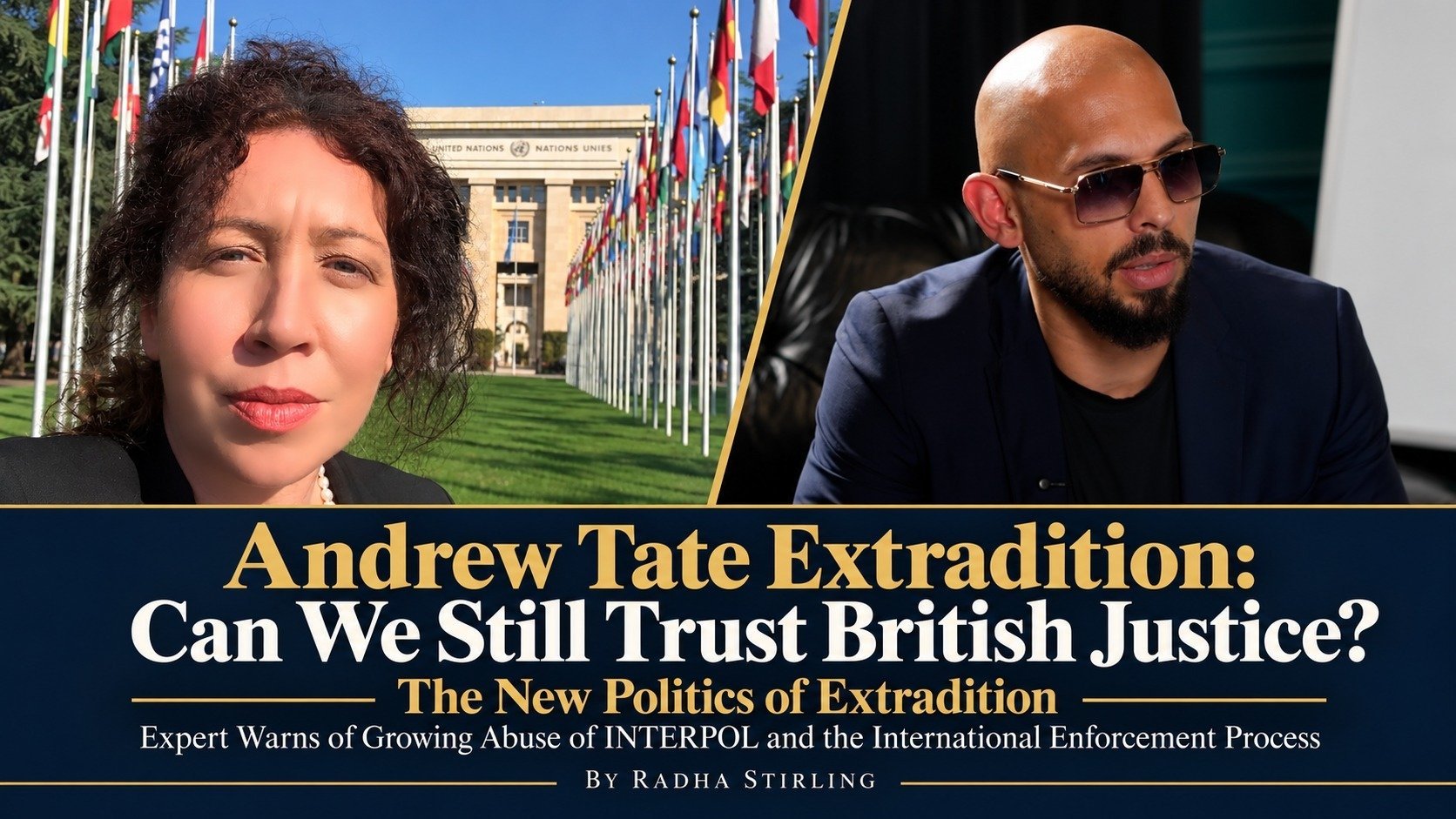
The New Politics of Extradition: Expert Warns of Growing Abuse of INTERPOL and the International Enforcement Process
Op-Ed By Radha Stirling, Extradition Expert Witness, founder of Due Process International and IPEX Reform. Stirling has helped countless female abuse victims over two decades as a leading human rights advocate. She's worked with Princess Latifa, Tara Reade (Biden victim) and Tori Towy but she's also seen first hand how the extradition process can be weaponized. Stirling discusses Tate’s pretrial detention and the future of British justice, asking whether public hostility is eroding the presumption of innocence and why bail protections must be strengthened for those fighting extradition.
Pre-extradition process hasn't been properly scrutinised since the weaponization of the judiciary became both a hot topic of conversation and a tragic reality. As it stands, we have a system that would allow a foreign country to lock someone up on the basis of untested and flimsy evidence. After gradually increasing complaints of Interpol abuse and arbitrary detention, pre-extradition process needs reform.
Whether you admire Andrew Tate or find him objectionable is irrelevant. Extradition should never be a popularity contest. The rights afforded to a defendant should not depend on whether the public approves of them. Due process exists precisely to protect those whom society has already judged. If we only defend the rights of the popular, we no longer have justice. We have mob rule dressed up as law.
The Tate case matters
For more than two decades, I have represented clients facing extradition, politically motivated prosecutions and abusive INTERPOL Red Notices. I have watched governments become increasingly creative in extending their reach beyond their own borders. International cooperation is essential in tackling genuine crime, but the legal safeguards designed to prevent abuse have failed to keep pace with the extraordinary powers governments now exercise.
Increasingly, extradition is no longer about bringing someone before a court. It’s about breaking them before they ever get there. A Scottish client of mine was arrested while on a job in Iraq. Why? Because a bank in Dubai falsely claimed he owed a small amount of money on a loan. Brian Glendinning spent months in a Baghdad hell hole while I negotiated with the high street bank to drop the Interpol warrant and extradition request. Financial disputes are not even extraditable offences but the system is left open to reframing disputes as “fraud”. It’s enough to get you locked up abroad.
When extradition becomes a human rights abuse
I’ve defended clients where the UK, the Netherlands, Denmark and Germany have sought the international arrest of targets who had not even been charged with a crime but were just wanted for questioning. Conor Howard’s Mediterranean family vacation was ruined when he was locked up in Greece for months on a Qatar Interpol warrant that would never realistically result in his extradition. Interpol and extradition is effectively a diplomatic process rather than a legal process and that leaves it open for incomprehensible abuse.
Claims do not need to be properly evidenced because the claim is not being assessed for its merit. A country can have someone arrested, even extradited without providing thorough or compelling evidence of a claim and that’s why the system has been weaponized repeatedly. When the West saw the Middle East, Venezuela, Russia and China requesting Interpol Red Notices and extradition, they rightly called out the judicial abuses but didn’t sever diplomatic relations, nor did we increase the burden of evidence required in order to protect and prevent people from politicised and weaponized requests and human rights abuses. Increasingly, we are seeing the Western nations acting in a similar manner. People like Chris Emms were targeted by the Biden administration and his financially incentivised cryptocurrency taskforce.
Where countries can issue an international asset freezing order, confiscate crypto and cash with the click of a button, have someone locked up abroad and subject to extradition proceedings that can last from months to years, and have them sent to a country (sometimes one they’ve never even physically been to) to face further imprisonment pending trial, it’s no wonder controversial, high profile or wealthy figures feel at risk of a world made small by lawless cross border enforcement.
Modern extradition allows governments to accuse first and litigate later. A person can spend years in detention or on restrictive bail before a jury hears a single witness. Their assets are frozen. Their bank accounts become inaccessible. Their cryptocurrency is seized or restrained. Their businesses collapse under the weight of legal costs. Their reputation is destroyed. Their family life disintegrates.
Even if they are ultimately acquitted, the punishment has already been served. If we accept this kind of treatment as collateral damage or the cost of justice, we have already lost.
I increasingly see Interpol has become a state tool for punishment by process precisely because of the lack of protections.
Tate brothers should be bailed
The Tate brothers' case illustrates many of these concerns. Whether they are guilty or innocent is not for me to decide. That is the job of a properly constituted court after all the evidence has been tested. My concern is whether the legal system itself still provides meaningful protection before someone loses years of their life to extradition proceedings. It is quite possible that extradition is ultimately denied or that they are found not guilty. It is totally unacceptable and disproportionate that they are locked up before extradition has even decided.
Bail laws require urgent review in light of the growing abuse of Interpol and extradition procedures by governments around the world who have documented instances of Interpol abuse. One of the most troubling developments is the increasingly expansive view governments take of jurisdiction.
The United States has repeatedly sought to prosecute non US citizens for conduct alleged to have taken place largely outside the United States. My former client Chris Emms became the subject of an American extradition request despite not being a US citizen and despite the alleged conduct occurring outside US territory. Julian Assange and Kim Dotcom likewise became symbols of how far governments are now prepared to extend their criminal jurisdiction across borders.
The United Kingdom has demonstrated similar determination. When conventional extradition presented obstacles in the case of Lee Murray, diplomatic efforts ultimately resulted in his prosecution in Morocco rather than Britain. Governments are increasingly willing to find alternative routes when traditional legal pathways become inconvenient. In the Tate’s case, the UK has followed the same playbook, seeking the cooperation of other countries in their pursuit of the Tates’ after they already investigated and let go.
UK Media Leverage for Downing Street
The pursuit of the Tates came at a politically convenient time, when a failing labor government had just installed a new and unelected Prime Minister at Downing Street. Despite private assurances that authorities would not pursue extradition from the US, a stealth action led to the brother’s very public arrest. An excellent opportunity for the UK media to change the subject from criticism of the government to Andrew Tate. It is actions like these that cause the British public to doubt the authenticity and truth of British justice.
Public trust in government is already deeply eroded. Cases involving Julian Assange, Lucy Connolly and Tommy Robinson raise different legal issues, but each prompts questions about the exercise of state power and the influence of media coverage. The government cannot expect unquestioning public confidence simply because a defendant is controversial or unpopular. That confidence depends on transparent decisions, proportionate treatment and the consistent protection of due process.
American criticism of Britain now goes well beyond disagreements over policy. JD Vance has publicly challenged Britain over restrictions on free speech, while Elon Musk criticised Tommy Robinson’s imprisonment. Among influential American conservatives, Britain is increasingly held up as a warning about state censorship and the treatment of political opponents. How, then, can US authorities justify denying someone bail while considering extradition to the very country they have criticised? If those concerns are serious enough to raise publicly, they must also matter when someone’s liberty is at stake. They cannot disappear simply because Britain asks for an arrest.
Financial Targets
The growth of cryptocurrency has transformed many entrepreneurs into internationally mobile holders of substantial wealth. Modern extradition is frequently accompanied by asset restraint orders, frozen bank accounts, cryptocurrency seizures and financial investigations that leave defendants unable to fund their own legal defence.
I have watched this happen repeatedly.
The public is told these measures preserve assets pending the outcome of criminal proceedings. Sometimes they undoubtedly do. But we should also acknowledge the extraordinary vested interest this creates and the leverage governments acquire once they can simultaneously seek extradition, freeze assets and litigate for years while the defendant struggles simply to pay lawyers. Imagine being a US citizen targeted by a foreign country that holds the extraordinary power to deprive you of liberty and freeze your bank accounts and assets without even testing the merits of their claim. It’s the making of a futuristic thriller.
The system now gives states immense power over an accused person long before guilt has been established. That should concern everyone.
The Tate case raises uncomfortable questions because assets, businesses and investments span multiple jurisdictions. Countries that once welcomed successful entrepreneurs and encouraged foreign investment can quickly become willing participants in international enforcement efforts. Wealth that appears geographically diversified often proves anything but.
The uncomfortable reality is that governments have discovered they no longer need to secure a conviction before exerting devastating pressure. The process itself frequently achieves the objective
Dual standards for Western nations.
Western democracies are often quick to condemn politically motivated prosecutions elsewhere. For example, if China sought the extradition of a prominent foreign businessman based on broad assertions of jurisdiction, many would immediately ask whether politics lay behind the request.
If the United Arab Emirates sought extradition in circumstances suggesting political influence or selective prosecution, those concerns would rightly receive close judicial scrutiny and bail is likely to be granted. Courts have refused extradition requests to jurisdictions where credible concerns existed about political interference or fair trial rights.
Yet when requests originate from Britain or the United States, there is often an assumption that democratic governments are somehow immune from the same temptations even when the evidence is thrown in our faces. History tells us they’re not immune.
Democratic governments are fully capable of political prosecutions, media driven investigations, selective enforcement and abuse of legal process. Allies should not receive a presumption of virtue simply because they share our political values. Justice requires scepticism, not blind trust.
Modern extradition also leaves defendants with remarkably limited opportunities to properly challenge allegations before surrender. That should trouble anyone who believes in the presumption of innocence.
A person can be fighting allegations made years or even decades after the alleged events. Witnesses disappear. Records are lost. Memories fade. Yet defendants are often told that the extradition hearing is not the place to test credibility or fully examine the evidence. In the Tate case, they are not even allowed to know the identity of the complainants. Instead, they are expected to wait until after extradition but by then, years may already have passed.
Julian Assange's legal battle demonstrated how extradition proceedings themselves can become an almost endless form of detention and litigation. Regardless of one's views about Assange personally, his case illustrated how the process alone can consume years of a person's life before the underlying criminal allegations are ever determined.
That is not an isolated concern. It is becoming an increasingly familiar feature of international criminal justice. Throughout my career I have also witnessed the misuse of INTERPOL by governments seeking to internationalise disputes that should never have crossed borders. Although INTERPOL has introduced important reforms, politically motivated notices and abusive requests continue to emerge from countries across the political spectrum.
The danger is no longer confined to authoritarian regimes. It exists wherever governments possess expansive legal powers with insufficient safeguards. People often assume these issues affect only organised criminals or fugitives though, increasingly, they affect entrepreneurs, investors, journalists, political dissidents, technology pioneers and cryptocurrency innovators whose activities naturally span multiple jurisdictions.
International mobility has become an advantage in business, but it has also become a vulnerability. The Tate case is not merely about Andrew Tate; it raises questions about whether modern extradition law still reflects the values it was designed to protect. Extradition was created to prevent genuine fugitives from escaping justice by crossing borders. It was never intended to become a system in which accusation alone can trigger years of detention, financial devastation, asset restraint and reputational destruction before guilt has been established.
Friendly governments should be examined with exactly the same rigour as unfriendly ones. If we would question an extradition request from China, Russia or another geopolitical rival, we should be equally willing to question one from Britain or the United States.
The rule of law cannot depend upon the flag flying over the requesting state or whether the defendant is fashionable to defend. The measure of any justice system is not how it treats those the public already supports, but how faithfully it protects the rights of those almost nobody is prepared to defend. If due process only exists for the popular, then it no longer exists at all.
Extradition reform
Andrew and Tristan Tate should not have to spend months in custody to discover whether Britain’s extradition request withstands scrutiny. US authorities should grant bail while that request is examined and require Britain to properly evidence its case. American leaders have openly questioned Britain’s treatment of dissent. Those concerns must count when deciding whether to surrender someone to British custody.
The Tate case shows why extradition law needs urgent reform. Courts must require more from requesting countries before depriving someone of their liberty. Treaties that permit prolonged detention without sufficient scrutiny of the allegations are unacceptable. The world has changed since many of the precedents restricting extradition bail were established. Governments are openly weaponising international enforcement, yet defendants are still left fighting for their freedom under rules that offer too little protection against that abuse. Legislators must establish a presumption in favour of bail, with detention requiring specific, evidenced reasons. Andrew Tate, like anyone fighting extradition, should be able to challenge the request without imprisonment becoming the punishment before a court has decided his case.
