
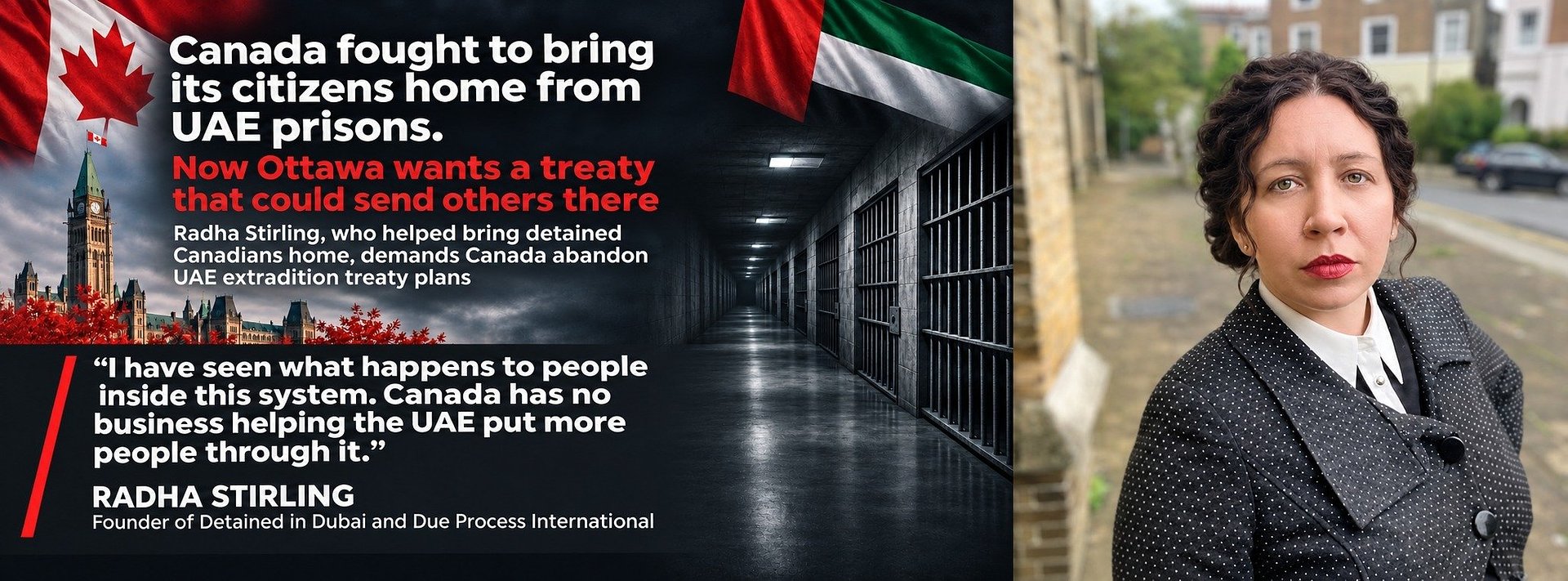
Canada fought to bring its citizens home from UAE prisons. Now Ottawa wants a treaty that could send others there
Radha Stirling, who helped bring detained Canadians home, demands Canada abandon UAE extradition treaty plans: “I have seen what happens to people inside this system. Canada has no business helping the UAE put more people through it.”
4 November 2026: International extradition expert Radha Stirling is calling on the Canadian government to abandon plans for an extradition treaty with the United Arab Emirates, condemning the proposal as a betrayal of Canadians who have suffered in its prisons and the families who fought to bring them home.
Stirling, founder of Detained in Dubai and Due Process International, has personally worked with Canadian families, ministers and diplomats to secure the return of citizens caught in UAE prosecutions. She says Ottawa knows precisely how difficult it can be to obtain justice once someone is in Emirati custody.
“I have worked with Canadian officials to get Canadians out of the UAE. I have dealt with the desperate families, reviewed the evidence and watched people’s health collapse while we fought to bring them home. For Canada to turn around and negotiate a treaty that could put others into the same system is appalling,” said Stirling.
“The Canadian government cannot plead ignorance. Its own officials have dealt with these cases. Its own travel advice warns about lengthy detention, denial of access to lawyers and women being detained after reporting sexual assault. Ottawa knows the dangers. It is choosing to negotiate anyway.”
Canada and the UAE announced plans to negotiate an extradition treaty and a mutual legal assistance treaty on 27 October, alongside a wider strategic partnership and trade agreement.
Stirling says Canada should refuse to enter an extradition treaty while the UAE continues to face unresolved findings of arbitrary detention and serious concerns over torture, coerced confessions and unfair proceedings. Trade and investment offer no justification for exposing people in Canada to that system. The government may defend their decision and defer human rights concerns to their judiciary but Stirling reminds us that the punishment is the process, “in those cases, the punishment is the lengthy and life altering process. Canadians should not be put at risk of this kind of abuse”.
Her Canadian cases include André Gauthier, who returned home in May 2021 following years of proceedings connected to the Gold AE investment scandal. Detained in Dubai exposed that he had helped uncover the fraud and was then scapegoated. Stirling worked with his family and Canadian officials to bring him home.
She also led the campaign for Maurice Kevin O’Rourke, the Ontario man initially sentenced to life imprisonment after being detained while transiting Dubai with cannabis products used on his doctor’s recommendation. His wife described a devastating deterioration in his health during detention. Following an appeal, his sentence was reduced to a fine covered by time served, and he returned to Canada on 1 March 2025.
These were Canadians whose families needed help getting them home. Stirling says their experiences should inform Canadian policy, rather than be forgotten when a new trade agreement is announced.
Canada also has the case of Salim Alaradi to confront. In Opinion No. 51/2015, the UN Working Group on Arbitrary Detention found the detention of the Canadian citizen and four other men arbitrary. It recorded enforced disappearance, secret detention, obstruction of access to lawyers and consular assistance, and reliable information concerning acts of torture.
The record is not confined to older cases. In its 2025 opinion on British businessman Albert Douglas, the Working Group found his detention arbitrary and identified a prima facie breach of the absolute prohibition of torture. In July 2026, UN experts intervened again over Ryan Cornelius, whose detention had already been found arbitrary in 2022.
The UN Committee against Torture has raised concerns about convictions based solely on confessions obtained through torture and failures to investigate abuse. UN scrutiny has also addressed discrimination and barriers to justice for foreign workers. Canada’s current travel advice explicitly warns that Emirati authorities have detained women reporting sexual assault.
“The UAE has had years to answer these cases and demonstrate that people will receive a fair trial and humane treatment. Signing treaties with more countries does not establish that it has done so. It gives the authorities greater reach while the underlying abuses remain unresolved,” Stirling said.
“In my work, the UAE has repeatedly stood out for its abuse of INTERPOL and its pursuit of people over commercial disputes dressed up as crimes. I have helped people challenge those requests and rebuild lives that were torn apart by them. Canada is proposing to give that same state a stronger means of pursuing people on Canadian soil. I am completely opposed to it.”
Stirling warns that the damage begins before anyone is extradited. “A UAE request can force a person into a fight against arrest, possible detention and ruinous legal costs in Canada. If surrendered, they could then face prolonged detention before trial in the Emirates. In Scotland, one of my clients was dragged through 2 year long stressful proceedings before the extradition was ultimately denied. Extradition requests cost the government millions to process and the UAE has a history of making frivolous and vindictive requests.”
Canadian courts and ministers would retain their responsibilities, including scrutiny of the evidence and the requirement that the alleged conduct be criminal in Canada. But those protections do not make abusive requests harmless. Describing a disputed business transaction as fraud or money laundering can leave a defendant fighting for years to expose what actually happened.
Stirling previously warned Ireland against exposing its citizens to wrongful extradition through a reciprocal UAE treaty. In her February 2026 statement, “Extradition for Sale”, she warned that wanted individuals were being used as leverage in diplomatic and commercial negotiations.
She encourages Canada to abandon the proposed extradition treaty and subject any wider justice cooperation to public parliamentary scrutiny, with evidence from former detainees, their families and experts who have challenged abusive UAE requests.
“I have seen what happens to people inside this system. Canada has no business helping the UAE put more people through it. Before Ottawa even considers an extradition treaty, it should insist on compliance with UN findings, independent investigations into torture and demonstrable protection against unfair trials. Those are basic obligations. The UAE should not be rewarded for failing to meet them.”
